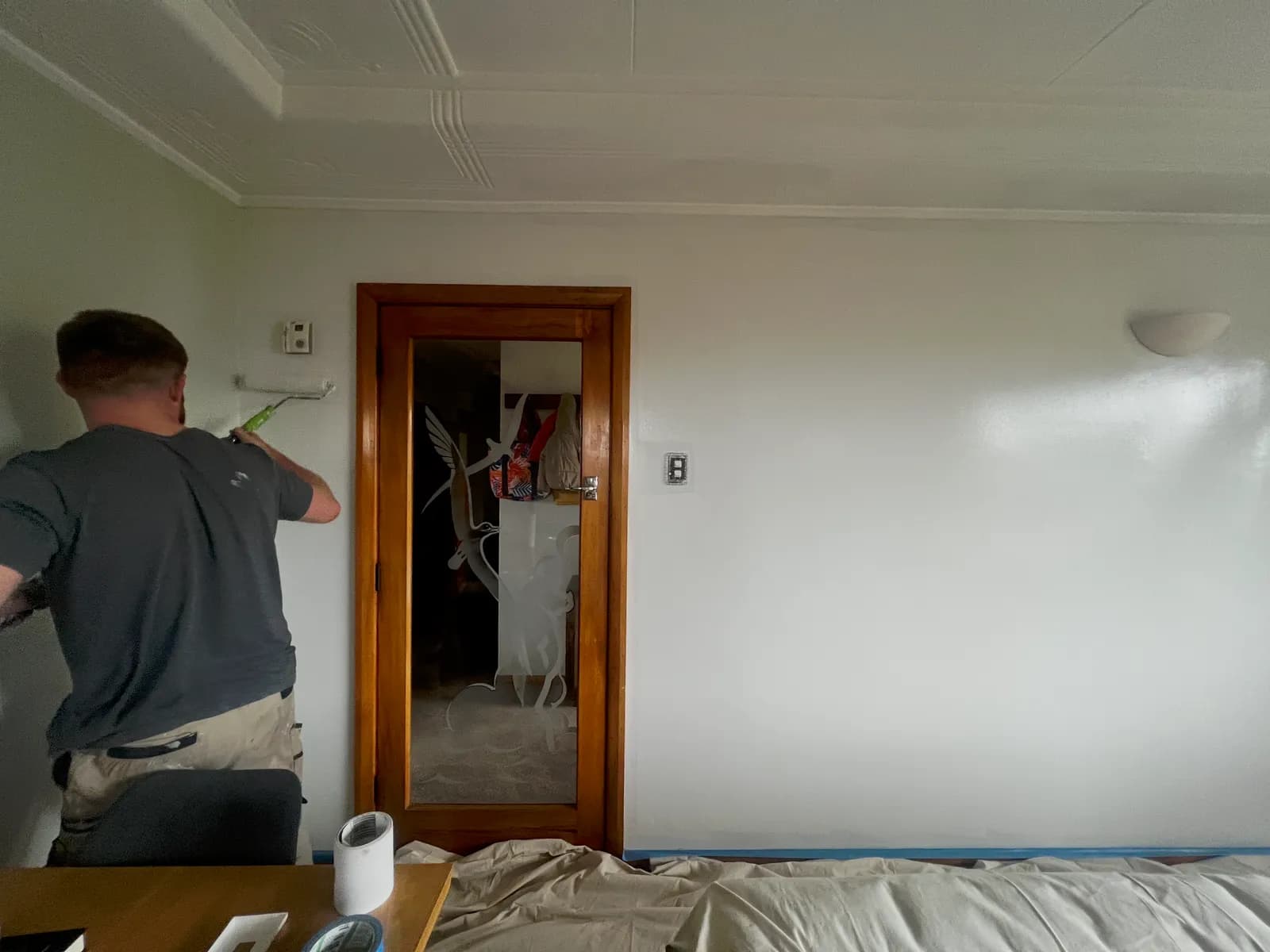
DIY Interior Painting in NZ: The Honest Homeowner's Guide (From a Painter Who's Seen It All)
Bradley Hamilton
Lakeside PaintingRight, let's have a real chat about DIY interior painting.
I've been painting Kiwi homes for over 14 years, and I'll be straight with you — most of the rooms I've been called in to fix were originally done by homeowners who watched a YouTube video, picked up a roller, and dove in. Not because they were lazy or hopeless, but because no one ever told them the boring stuff that actually matters.
This isn't another "10 painting hacks" listicle. This is the conversation I'd have with you over a coffee in Wanaka if you'd just bought a house and asked me what you actually need to know before you start. No fluff, no jargon, no upselling. Just the stuff that decides whether your paint job looks great in five years — or starts peeling in eighteen months.
The One Thing That Decides Everything: Prep
If you only read one section of this guide, make it this one.
I reckon 80% of a good paint job is prep, and 20% is paint. Homeowners flip that ratio — they spend a Saturday taping and a whole Sunday rolling — and that's why their job looks tired by the time their second winter rolls around.
Here's what proper prep actually looks like:
- Wash the walls. Sugar soap and warm water. Dust, kitchen grease, hand oils from light switches, kids' fingerprints, even just airborne grime — paint doesn't stick to any of it. Skip this step and you're basically painting on Teflon.
- Fill every hole and crack. Use a flexible filler for hairline cracks (these move with the seasons, especially in older NZ homes with timber framing), and a standard polyfilla for nail holes and dings.
- Sand everything. Not aggressively — just enough to knock the gloss off old paint and feather out your fillers. A medium-grit sanding block does most rooms in under an hour. Wipe down with a damp microfibre after.
- Tape, drop sheets, then tape again. Mask anywhere you don't want paint to land. Don't skimp on drop sheets either — paint splatters travel further than you'd believe.
I know this sounds tedious. It is. But here's the trade-off: every hour you spend on prep saves you about three hours of cutting in around bad surfaces, fixing flashing, and doing extra coats to cover patchy bits. Prep isn't the boring bit before the painting — prep is the painting.
Primer: The Step Most Homeowners Skip (And Shouldn't)
Primer is the most misunderstood product in the paint aisle. Let me make it simple.
You need to prime when:
- You've patched holes or cracks (raw filler will suck the paint right out of your topcoat, leaving dull patches called "flashing")
- You're painting over bare timber, MDF, or fresh plasterboard
- You're going from a dark colour to a light one
- You're painting over a glossy surface (kitchen cupboards, trims, old enamel walls)
- The existing paint is stained from leaks, smoke, or crayon
You can probably skip primer when:
- You're applying the same or similar colour over sound, clean, low-sheen paintwork
- It's a quick freshen-up rather than a proper redecorate
When in doubt, prime. Resene Quick Dry is the workhorse most painters in NZ reach for — it's water-based, blocks stains reasonably well, and you can topcoat it within a couple of hours. If you've got water marks or tannin bleed from old timber, step up to Resene Sureseal or a shellac-based blocker like Zinsser BIN.
A primer coat costs maybe $40 in product and an extra hour of your time. It's the cheapest insurance you'll ever buy for a paint job. If you want a deeper dive into when and why, I covered it in Picking the Right Primer.
Choosing Paint: Stop Overthinking It
Walk into Resene or Guthrie Bowron and you'll see hundreds of options. Here's the truth: for 90% of interior rooms in a Kiwi home, you only need to make three decisions.
1. Water-based, always.
Forget oil-based for walls and ceilings. Water-based (acrylic) paints have come a long way — they're low-odour, dry fast, clean up with water, and these days they're more durable than the old enamels for most interior uses. The only place I still occasionally use enamel is on doors and trims where I want a glass-smooth finish, and even then waterborne enamels like Resene Enamacryl or Dulux Aquanamel hold up beautifully.
2. Pick your sheen based on the room.
- Ceilings: Flat or matte. Hides imperfections, no glare.
- Bedrooms & lounges: Matte or low sheen. Calm, modern, easy on the eye.
- Hallways, kids' rooms, living areas: Low sheen. Wipes clean without showing every scuff.
- Kitchens & bathrooms: Low sheen or semi-gloss with a mould-inhibitor (Resene SpaceCote Low Sheen Kitchen & Bathroom is purpose-built for this).
- Doors, trims, skirtings: Semi-gloss or gloss. Durable, easy to clean, and gives that crisp finished look.
If you want to go deeper on sheen, I wrote a whole guide on this — The Sheen Spectrum: When to Choose Matte, Low Sheen, or Gloss.
3. Don't buy cheap paint.
This is the single best piece of advice I can give you. Cheap paint is a false economy. You'll need more coats, the colour will look flat, the finish will be patchy, and it'll wear out faster.
Stick with the proven NZ brands: Resene, Dulux, or Wattyl. Their mid-tier products (Resene SpaceCote, Dulux Wash & Wear, Wattyl Solagard for exteriors) are what professional painters use day-in, day-out. You're looking at $90–$130 for a 10L pail. A standard 3x4m bedroom needs about 4L for two coats, so we're talking maybe $50–$70 of paint per room. Don't cheap out here.
What You Actually Need to Buy (And What You Don't)
The paint aisle is designed to overwhelm you. Here's a stripped-back DIY kit that'll do almost any room:
- One 4L pot of your chosen wall paint (per room, roughly)
- One 1L pot of trim paint (semi-gloss, water-based)
- Two roller frames (one for ceilings, one for walls — saves washing mid-job)
- A pack of decent roller sleeves — 10mm nap for normal walls, 12mm if your walls are textured. Don't buy the cheap fluffy ones; they shed.
- A 50mm angled sash brush for cutting in. Spend $25 here; a good brush is the difference between sharp lines and a wobbly mess. (More on that in Picking Paint Brushes in New Zealand.)
- A 25mm brush for fiddly bits
- Sugar soap, sandpaper (120 and 240 grit), filler, scraper, putty knife
- Painters' tape (Frog Tape if you can find it — green or yellow), drop sheets, paint tray
- A roller pole extension — your back will thank me
That's about $200–$250 in tools and consumables for your first room, and most of that gear is reusable for years.
What you don't need: paint sprayers (overkill for a single room, plus the masking and clean-up is a nightmare for first-timers), edging tools (the rubber-wheel ones are a gimmick — a steady brush is faster), or "ceiling paint with the colour-change indicator." Just buy regular paint.
The Order of Operations
This is where a lot of DIY jobs go sideways — people paint in the wrong order and end up redoing bits. Here's the order I work in every single time:
- Prep the room (clear furniture, sand, fill, sand again, wash, mask)
- Prime any bare or patched areas
- Paint the ceiling first (always — drips fall down)
- Paint the walls (cut in around edges with a brush, then roll the main field while the cut-in is still wet — this is called "keeping a wet edge" and it's how you avoid lap marks)
- Paint the trims, skirtings, and doors last (because they're the smallest area and you can be precise without worrying about messing up walls)
- Remove tape while the paint is still slightly tacky (peeling tape off fully-dry paint can pull paint with it)
Two coats. Always two coats. I don't care what the tin says. One coat looks fine when wet and patchy when dry.
The Central Otago / Wanaka Wildcard: Climate
If you're reading this from anywhere between Cromwell and Queenstown, you've got a few extra things to think about that someone in Auckland doesn't.
Temperature swings. A Wanaka winter morning can be -3°C and the afternoon sun can push an interior wall (especially a north-facing one) up to 25°C+. Most paints have a working temperature window of about 10–30°C. Painting on a freezing morning in an unheated room is a recipe for poor adhesion and a chalky finish. Wait for the day to warm up, or chuck a heater on for a few hours first.
Low humidity. Central Otago is one of the driest inhabited places in NZ. That makes paint dry fast — sometimes too fast. If you're cutting in and the paint is already tacky by the time you start rolling, you'll get visible lap marks. Work in smaller sections than you'd think, and don't paint in direct sunlight on a wall.
Dust. Schist dust, lake dust, dry-grass dust — it gets everywhere. Wash your walls thoroughly before painting, and try to keep windows closed (or at least screen-side only) while paint is wet.
Old plaster and timber-framed homes. Lots of older Wanaka, Arrowtown, and Hawea homes have native timber framing, lath-and-plaster walls, or scrim ceilings. These move more than modern Gib, especially seasonally. Use a flexible filler, and budget for a few hairline cracks reappearing within a year — that's just what these old places do. It's not a paint failure; it's the house breathing.
The Five Mistakes I See Every Single Week
Pulled together from a decade and a half of fixing other people's paint jobs around the South Island:
1. Rolling too fast and too hard
Paint wants to lay flat. Light, even pressure, a consistent "W" or "M" pattern, then a final light pass in one direction to even out the texture. If you can hear your roller spattering, you're going too fast.
2. Not loading the brush properly
Dip the bristles in about a third of the way, tap (don't wipe) the excess off on the side of the pot. A starved brush leaves streaks; an overloaded one leaves runs. You'll get the feel after about 10 minutes.
3. Painting straight onto bare filler
Filler is porous. Paint sinks into it differently than it sinks into the surrounding paint, and you end up with visible dull patches called "flashing." Always spot-prime your fillers before the topcoat.
4. Cutting in, then waiting an hour before rolling
When your cut-in dries before you roll up to it, you get a visible line where the brushwork meets the roller work. Cut in one wall, roll it, then move to the next. Keep that wet edge.
5. Trying to paint over mould without treating it
If you've got mould in a bathroom or behind a wardrobe, paint won't kill it — it'll grow right through. Wash with a 1:4 bleach solution, let it dry properly, then prime with a sealing primer before topcoating. Otherwise it'll be back in six months looking worse.
How Long Should It Actually Take?
Homeowners massively underestimate this. Here's a realistic budget for one average bedroom (about 3m x 4m, standard ceiling height):
- Prep (washing, filling, sanding, taping): 3–4 hours
- Priming patches and any bare spots: 1 hour + drying time
- Ceiling, two coats: 2–3 hours
- Walls, two coats: 4–6 hours
- Trims, skirtings, door: 2–3 hours
- Clean up: 1 hour
So you're looking at roughly a full weekend to do one room properly, not the "I'll knock it out Saturday morning" plan most people start with. Plan for that and you won't feel demoralised halfway through.
When to Stop and Call Someone
I'm a painter, so of course I'm going to say this — but I really do mean it. DIY makes sense when:
- It's a single room or feature wall
- The surfaces are in reasonable condition
- You've got the time and patience to do the prep properly
- You're okay with a result that's "good," not "flawless"
It stops making sense when:
- You're painting a whole house and the prep is going to take weeks
- There's significant damage, mould, or peeling paint that needs proper diagnosis
- You're working at height (stairwells, two-storey voids, exteriors above ground floor) — falls from ladders are the most common painter injury and they're not worth it
- You want a high-gloss or pigmented dark finish where every imperfection shows
- You're doing it to sell the house and need it to look professional
If you're somewhere around Wanaka, Queenstown, or Central Otago and you'd rather hand it off — that's literally what I do. You can find me at Painters Wanaka for painting jobs, or Wanaka Wallpapering if you've decided a feature wall in paper is more your thing. No pressure either way — half the people who email me end up doing the job themselves with a few extra tips, and that's a win in my book.
A Few Final Bits of Hard-Won Advice
- Buy more paint than you think. Running out halfway through a wall, then coming back with a fresh tin from a different batch, is how you end up with subtle colour mismatches. Always over-order by 10–15%.
- Write the colour code and brand on the back of a light switch plate. Future-you will thank present-you when you need to do touch-ups in three years.
- Don't pick a colour from a tiny swatch. Get a Resene testpot, paint a decent A3-sized patch on the actual wall, and live with it for 48 hours. Colours change dramatically with light, time of day, and surrounding furnishings. (More on choosing colours here.)
- Take photos of your prep. Sounds weird, but if anything goes wrong later (a stain coming through, a crack reappearing), you'll want to remember what was underneath.
- Have a beer at the end. You've earned it.
Painting your own home is one of those rare DIY jobs where the results genuinely transform how you feel about a space — and you absolutely can do a great job yourself. The people who do it well aren't the ones with the steadiest brush hand; they're the ones who slow down on prep, buy decent paint, and follow the order of operations.
If you want to go deeper, here are a few related guides on the site that might help:
- The Complete Interior Painting Guide
- The Sheen Spectrum: When to Choose Matte, Low Sheen, or Gloss
- Saving Money on DIY Painting
- Picking the Right Primer
Good luck with the project. Take your time, and remember — paint dries faster than regret. Get the prep right, and the rest mostly takes care of itself.

About the Author
Bradley Hamilton
Bradley Hamilton is a seasoned painter with over 14 years of experience in the industry. Having worked with a wide range of clients, from homeowners to commercial businesses, he has developed a deep understanding of what it takes to deliver exceptional painting results. His expertise spans both interior and exterior projects, with a focus on quality craftsmanship and attention to detail. Now combining his passion for painting with his skills in web development, Bradley helps painting businesses build a strong online presence, sharing valuable insights and tips to help improve their services and grow their customer base.
Visit Lakeside Painting
Comments
Join the conversation by signing in
No comments yet.
Be the first to share your thoughts!