Grey, Brown or Black? How to Read What's Actually Happening to Your Cedar
Bradley Hamilton
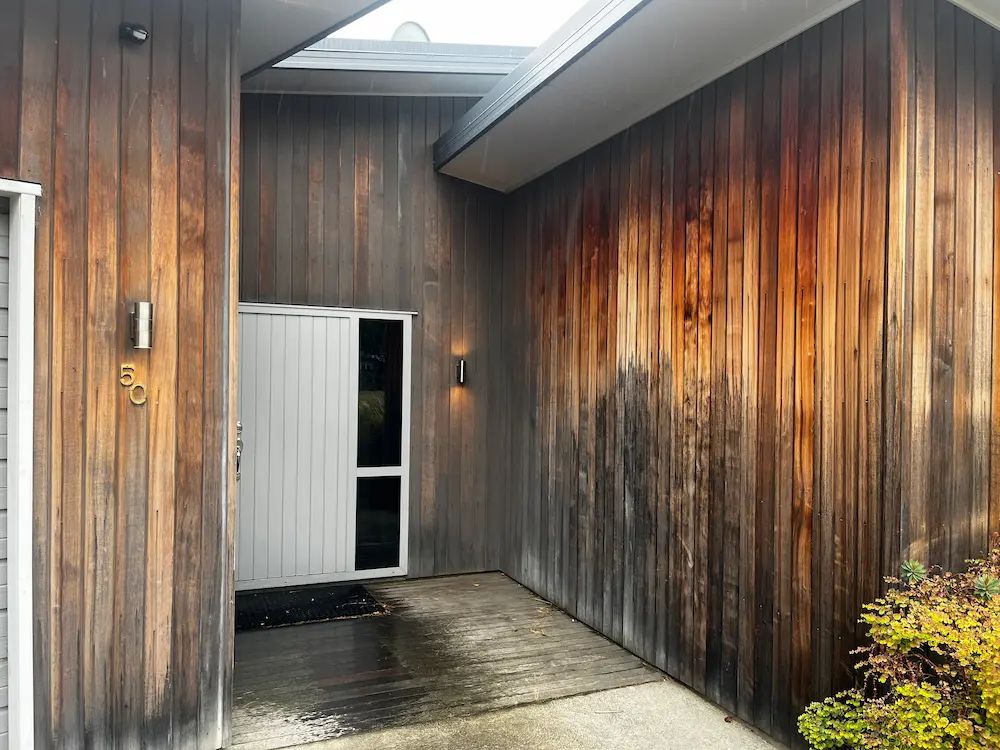
Lakeside PaintingHere's a thing that catches people out. Two cedar homes, same street, same builder, same stain, signed off the same month. Three years on, one's gone an even silver-grey and the owner's relaxed about it. The other's gone dark and blotchy under the eaves and the owner's convinced the place is rotting.
Same timber. Same sun. Completely different colour. So what gives?
The short version is that the sun doesn't actually decide the colour. UV only ever does one thing to cedar. What you end up reading on the wall - grey, brown-black or a furry black - is decided by what happens after the UV does its bit: how much rain hits that face, and whether it dries out or stays damp and shaded. Get that, and you can walk a wall and diagnose it on the spot.
Rather than just tell you, I've built you the wall. Have a play with it: drag the sun across, switch the rain on and off, throw it into damp shade, and watch the same starting point finish three different ways. Then I'll walk through each one underneath.
UV always does one thing: it strips the lignin and makes brown chromophores. What colour you actually end up reading on the wall is decided by rain and moisture after that, not by the sun. Drive the three controls and watch the wall change.
The whole thing in three lines
The fourth black, off to the side: iron tannate
Not weathering at all. Iron (rusting fixings, steel wool, bore water) meets cedar's tannins and forms a blue-black stain soaked into the wood. Concentrated round nail heads, won't scrub off. That's an oxalic-acid job, and a flag.
On site: dark + sheltered = suspect dark weathering (in the wood). Dark + exposed = suspect grey-plus-mould (film off sound timber). Location vs rain is the tell.
The one thing UV always does
Strip everything else away and ultraviolet light does a single job on cedar: it smashes up the lignin.
Lignin is the natural glue that binds the wood fibres together, and it's loaded with the molecular rings that soak up UV. When the sun works on an unprotected surface, those rings break apart into smaller, brown-coloured compounds - chemists call them chromophores, which just means "the bits that carry colour." This is happening in the top fraction of a millimetre, and it happens to every sun-exposed cedar surface on earth, no exceptions.
Notice what UV does not do: it never makes black on its own. It makes a brown breakdown product and then stops. Everything that happens next - silver, dark, or furry black - is decided by water, not by the sun. That's the whole trick to reading a cedar wall.
Grey: the rain washed it away
This is the common one, and the most misunderstood. On a face that gets rain, every shower rinses those broken-down brown lignin bits straight off the surface. What's left behind is bare, bleached cellulose - the structural fibre - and cellulose doesn't carry colour the same way. It just scatters light, and our eyes read that as silver-grey.
So grey is genuinely a washed surface. The timber underneath is usually still sound, which is why "let it go grey" is a legitimate look and some people chase it on purpose — and if you don't like it, the warm tone can be brought back.
The catch is what the grey represents: the surface has lost its lignin and, with it, its water repellency. It now drinks water, wets and dries, and over enough seasons that's when checking and splitting start. Up here at 300-plus metres with our hard nor'west UV, north and west faces get there fast. Grey is your early-warning light - sound today, but asking for a clean and a recoat.
Brown-black: the sneaky one that stays IN the wood
Now switch the rain off in the panel and leave the sun on. Watch it go dark instead of grey.
This is the one nobody expects, and it's the one I get called about most under the heading of "I think my cedar's rotting." It isn't. On a sheltered surface - soffits, eaves, the underside of a verandah ceiling, deep reveals - UV still reaches the timber and still makes those brown chromophores. But there's no rain to wash them off. So instead of leaving, they just pile up, season after season, until the surface reads as a deep brown-black.
The tell is location. This dark sits exactly where rain can't reach: up under the soffit line, never out on the weather face. And here's the important part - it's in the wood, not on it. It's stained into the surface fibres, so it won't lift off as a film, and a scrub with a brush won't shift it back to honey. Bringing those areas back means cutting the discoloured surface back to sound timber (a timber brightener or a light sand), which is exactly the line between a refresh and a restoration I dig into in Cedar Oil Refresh vs Full Restoration.
Brad's take: if the dark patch is somewhere rain never touches and a wet scrub does nothing, you're almost certainly looking at dark weathering, not mould and not rot. It's a cosmetic stain that needs prep, not a panic.
Furry black: mould moved in on top
Flip the "shaded & damp" toggle on in the panel and you get a different black again - and this one's a living thing.
Cedar comes with its own defence team: natural oils and extractives (the thujaplicins and friends) that make it genuinely mould-resistant when it's fresh. That's why new cedar shrugs off the damp — though don't mistake that for UV resistance, which is a completely different problem on a new build. But once UV has weathered the surface and those extractives have leached out, the defence is gone - and on a damp, shaded face, a surface fungus (mostly Aureobasidium) moves straight in. It feeds on the old oil, the dirt and the exposed fibre, and spreads as a grey-black film.
The key difference from dark weathering: this black is on the timber, not in it. It's a surface colony. Wet it down, give it a scrub, and sound timber should appear underneath. That makes it the most fixable of all the blacks - a proper soft wash and a treatment knocks it back, then you recoat to stop it returning. Never reach for the water blaster, though; cedar's soft and you'll fur the grain and make the next colony's job easier.
The fourth black, off to the side: iron tannate
There's one more black worth knowing, and it's not weathering at all - it's a chemical reaction. Cedar is acidic and tannin-rich, and when water carries those tannins into contact with iron - a non-stainless nail, a screw, stray steel-wool filings, or iron in bore water - they bond into a dark blue-black stain that soaks into the wood. It's the same chemistry old iron-gall ink was made from.
The tell here is the pattern: it's concentrated in streaks running directly below the fixings, not spread across a face. It won't scrub off, and oiling over it just buries it. The fix is an oxalic-acid treatment to lift the stain, and the upstream fix is the real lesson - stainless fixings only on cedar. If you're seeing this, someone used the wrong nails, and it'll keep bleeding until it's dealt with. There's more on the chemistry behind this in The Chemistry of Cedar.
Reading it on site: the GO / NO-GO
When I walk a cedar home, I'm running a quick decision tree in my head, and it comes down to location versus rain:
- Even grey on a weather face → washed and sound. Mostly cosmetic, but the protection's gone. Clean and recoat before it checks.
- Dark and even, up where rain never reaches (soffits, eaves, reveals) → dark weathering, stained into the wood. Needs prep back to sound timber, not just a wash.
- Patchy grey-black on a damp, shaded face that scrubs off → surface mould. The easiest fix: soft wash, treat, recoat.
- Black streaks lined up under the nails → iron reaction. Wrong fixings. Oxalic-acid job, and replace the fasteners.
The two that get confused are the dark ones, so here's the clean rule: dark + sheltered = suspect dark weathering (in the wood); dark + exposed and damp = suspect mould (on the wood). If a wet scrub brings timber back, it was on top. If it does nothing, it's gone in. That single test sorts most of it.
The honest bottom line
Cedar isn't doing anything mysterious. UV makes one brown breakdown product, and then water writes the ending - washed off to grey, piled up to dark weathering, or colonised by mould in the damp. Knowing which one you're looking at is the difference between a cheap clean-and-recoat and an unnecessary panic about rot, or between a quick wash and burying an iron problem you'll be fighting for years.
If you're staring at a cedar home around Wānaka, Hāwea or Queenstown and you can't tell which black you've got, that's exactly the call I like getting - I can usually read it on the spot and tell you whether it's a recoat or something more. There are before-and-afters of jobs at each of these stages over on lakesidecedar.co.nz if you want to see what the fix actually looks like. Get in touch and I'll come take a look.
Read the wall, and the wall tells you what to do.
— Brad

About the Author
Bradley Hamilton
Bradley Hamilton has been staining and restoring cedar across Central Otago for 15 years. From maintenance oil refreshes to full strip-and-restains, he's worked through every product on the market in this climate and writes about what actually holds up. He also runs Lakeside Painting in Wānaka.
Visit Lakeside Painting
Comments
Join the conversation by signing in
No comments yet.
Be the first to share your thoughts!