
Restaining Cedar When You Don't Know What Was on It Before
Bradley Hamilton
Lakeside PaintingOne of the most common questions we get on cedar jobs around Wānaka isn't "what colour should I go?" — it's "do you know what was used on it last time?"
Usually the answer is no. The owners bought the house ten years ago, the original builder is long gone, the records don't exist, and the cedar's now faded to the point where bare timber is starting to show through on the sun-facing elevations. You can't ring the manufacturer of something you can't identify. So what do you actually do?
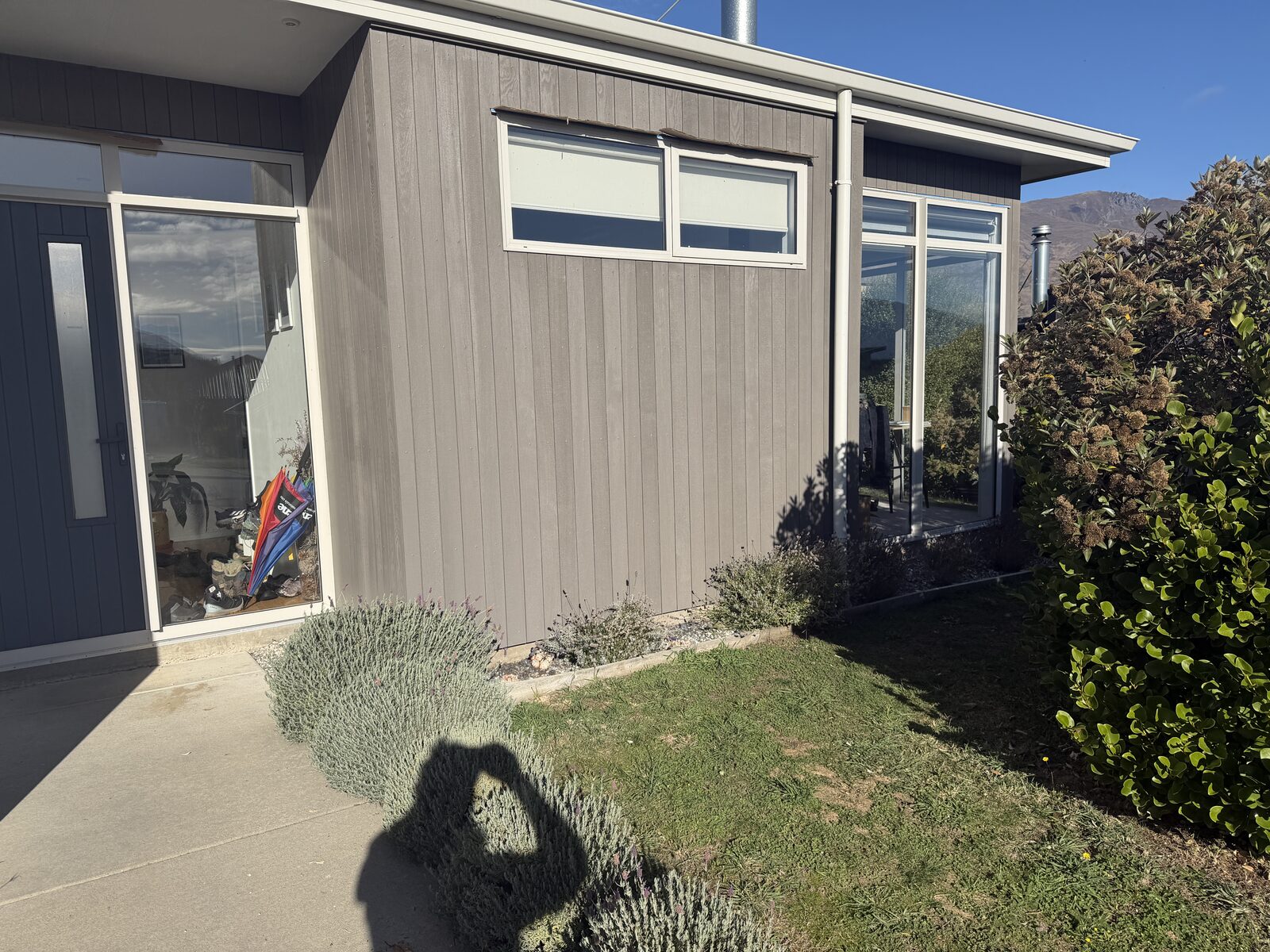
That was the situation on a recent job we wrapped on McLeod Avenue here in Wānaka.

The problem with mystery coatings
Cedar stain compatibility actually matters. Get it wrong and you can end up with a finish that bubbles, lifts, or simply refuses to dry properly because the new product can't get into the timber past whatever's already there. That's why most painters will quietly tell you their first preference is "start from bare" — if you sand it back, you know exactly what you're working with.
The trouble is, a full sand-back on a cedar home is a serious chunk of work — both in time and dollars. On a maintenance job where the timber's tired but not actually failing, going straight to a full strip is overkill.
So you're stuck between two bad options: gamble on compatibility with an unknown product, or pay for a restoration the cedar doesn't really need.
What the Resene rep suggested
We talked it through with our Resene rep before quoting, and he pointed us at Resene Woodsman Cedar Natural Wood Oil. It's a relatively new product in their range, and the pitch is exactly what we needed: it's formulated to be applied over weathered, unknown mineral-oil-type stains — the category that covers most of what's been used on cedar homes around here, including Dryden WoodOil and Wood-X.
The Resene datasheet backs this up. It explicitly says the product "can be used over weathered mineral oil stains." The catch — and this is important — is that it's not suitable over intact film-forming stains, or over recently applied (still active) mineral oil stains. So it's not a silver bullet for every situation. But for cedar that's clearly weathered, where the previous coating has worn down and the timber is hungry for oil again, it ticks the boxes.
That described the McLeod Ave cedar perfectly.
The prep
We didn't skip any steps just because the product was billed as forgiving. The cedar got a proper wash with Resene Timber and Deck Wash — scrubbed in, left to do its work, then rinsed off. That step is non-negotiable. Any residual dirt, mould, or surface grime stops the oil penetrating evenly and you'll see it in the finish.
Once it was dry, we did a test patch in an inconspicuous spot. No bubbling, no lifting, the colour pulled in nicely. Good to go.
How the product actually behaves
This is the part worth flagging if you're used to traditional penetrating cedar oils.
On first impressions, Resene Woodsman Cedar Natural Wood Oil felt more like paint than stain. It smelt like paint going on, it looked like it was sitting on top of the timber the way paint would, and we had a moment of "are we sure this is the right product?" while we were cutting in around the windows.
But it dried like a proper stain. By the time we came back for the second coat the surface had pulled into the timber, the sheen had dropped right back, and you could see the grain coming through. Two coats in and the cedar looked deep, warm, and even — no patchiness, no shiny film, no sign of the previous coating arguing with the new one.
What to take away
If you're staring at a tired cedar home in Wānaka or Queenstown and nobody can tell you what was on it before, you don't automatically have to budget for a full sand-back. The honest checklist:
Is the previous coating film-forming and still intact? (Test: scratch a corner — if it peels off in a sheet, it's a film, and you've got a different problem. We wrote about that one here.)
Is it weathered and worn-in rather than peeling? If yes, you're in the zone where a product like Resene Woodsman Cedar Natural Wood Oil can save you a restoration-sized invoice.
Has it been recoated in the last year or two? If so, the previous oil may still be active and you'll want to wait, or get a painter to do a proper test patch.
The general rule we work to: when the previous product is a mystery but the cedar's clearly weathered, this is the safest "go over it" option we've found. It's not a free pass — you still wash it properly, you still test it first — but it bridges a gap that used to mean either a gamble or a full strip-back.
Got tired-looking cedar and no idea what's on it? We're happy to take a look and give you a straight answer before you commit to anything — get in touch via Painters Wanaka. And if the test patch says the old coating does have to come off, Lakeside Cedar is the side of the business that handles full strip-and-restore work.
Photos and details from a real job carried out by Lakeside Painting Limited at McLeod Avenue, Wānaka. The author also runs Painters Wanaka, serving the Central Otago region.

About the Author
Bradley Hamilton
Bradley Hamilton has been staining and restoring cedar across Central Otago for 15 years. He writes about what actually holds up in Wānaka's UV, and what to do when the last coat is a mystery.
Visit Lakeside Painting
Comments
Join the conversation by signing in
No comments yet.
Be the first to share your thoughts!