Bradley Hamilton
Lakeside Painting
The $800 Mistake That's Easier to Make Than You'd Think
Picture this: a couple in Arrowtown falls in love with a gorgeous deep green paint colour at the Resene shop. It looks incredible under the showroom lights—sophisticated, moody, perfect for their master bedroom. They buy eight litres and spend a weekend painting.
Monday morning, they wake up in what feels like a cave.
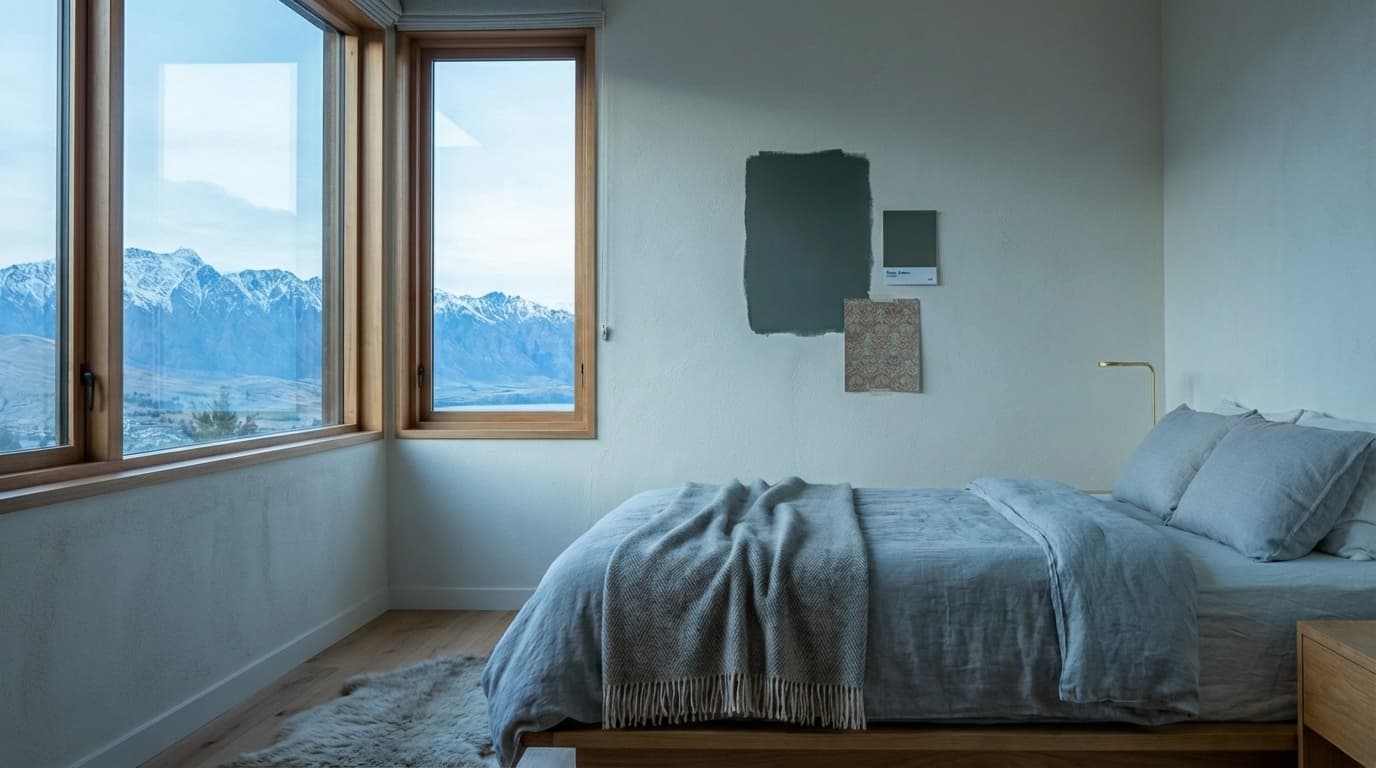
Their south-facing bedroom, which gets virtually no direct sunlight, has turned that beautiful deep green into something resembling the bottom of a swamp. The colour that looked rich and inviting under warm showroom lights looks cold, flat, and oppressive in their actual home.
Now they're facing a repaint. That's $800 in wasted paint and labour, plus the cost of getting it right the second time.
I see variations of this story from time to time—someone chooses a colour that looked perfect in the shop or on a sample card, only to find it looks completely different once it's on their walls. It's an easy mistake to make, and it almost always comes down to one thing: New Zealand light is different.
Understanding how it works will save you from expensive mistakes—whether you're choosing paint colours, selecting wallpaper, or planning a complete interior refresh.
Why NZ Light Is Different (The Science Bit)
I'm not going to bore you with physics, but you need to understand a few things about why colours behave differently here than they do in, say, London or Los Angeles.
We're Closer to the Ozone Hole
New Zealand sits under one of the thinnest parts of the Earth's ozone layer. That means more UV radiation reaches us—about 40% more than equivalent latitudes in the Northern Hemisphere.
What this means for your walls:
- Colours appear more intense and saturated
- Shadows are sharper and more defined
- The contrast between lit and unlit areas is more dramatic
- Paint fades faster (especially on exterior surfaces)
Our Light Is Bluer
The quality of light in New Zealand has a cooler, bluer cast compared to European or North American light. This is partly due to our clean atmosphere and partly due to how light reflects off our oceans and landscapes.
What this means for your colour choices:
- Warm colours (reds, oranges, yellows) can look more vibrant than expected
- Cool colours (blues, greens, greys) can look colder and harsher
- Whites often appear more stark and clinical
- Creams and off-whites can look dingy or yellowish
Our Seasons Are Dramatic
In Central Otago, we experience massive seasonal light changes. Summer days are long and intense; winter days are short and the sun sits low in the sky. The angle of light coming through your windows changes dramatically throughout the year.
What this means for your interior:
- A colour that looks perfect in January might feel completely different in July
- Rooms that are bright and airy in summer can feel dark and enclosed in winter
- You need to consider how a space will feel across all seasons, not just when you're choosing colours
Room Orientation: The Most Important Factor Nobody Talks About
Before you pick a single paint colour or wallpaper sample, you need to understand what direction your room faces. This affects everything.
North-Facing Rooms (The Sweet Spot)
North-facing rooms in New Zealand get consistent, warm sunlight throughout the day. They're the easiest rooms to decorate because the light is reliable and flattering.
What works:
- You can go bold with colours—the consistent light supports drama
- Cooler tones (blues, greens, greys) are balanced by the warm natural light
- Deep, saturated colours work well without feeling oppressive
- Matte and low-sheen finishes look sophisticated in this light
What to avoid:
- Very warm colours (oranges, strong yellows) can feel overwhelming
- High-gloss finishes can create harsh glare spots
Wallpaper tip: North-facing rooms are ideal for textured wallpapers and grasscloth—the consistent light shows off the texture beautifully without creating harsh shadows.
South-Facing Rooms (The Challenge)
South-facing rooms are the trickiest in New Zealand homes. They get minimal direct sunlight—mostly cool, diffused light reflected from the sky. In winter, they can feel genuinely dark and cold.
What works:
- Warmer tones: soft beiges, warm greys, creamy whites
- Paint colours with yellow, pink, or peach undertones
- Lighter colours overall to maximise the limited light
- Semi-gloss or satin finishes that bounce light around
What to avoid:
- Cool greys and blues (will feel like a freezer)
- Dark or saturated colours (will absorb what little light there is)
- Matte finishes (don't reflect enough light)
- Heavy, dark wallpaper patterns
Wallpaper tip: If you want a feature wall in a south-facing room, choose patterns with light backgrounds and avoid anything too dark or busy. Metallic accents can help bounce light around.
East-Facing Rooms (Morning Glory)
East-facing rooms get beautiful warm light in the morning and cooler, shadowed light in the afternoon. They're great for bedrooms and breakfast nooks.
What works:
- Warm neutrals that look good in both warm and cool light
- Soft, muted colours that won't look jarring as the light changes
- Blues and greens that feel fresh in morning light
- Medium-toned colours rather than extremes
What to avoid:
- Very bright colours that will look harsh in morning sun
- Very dark colours that will feel gloomy by afternoon
West-Facing Rooms (Afternoon Drama)
West-facing rooms get dramatic afternoon and evening light—often golden and intense. They're perfect for living rooms where you want warmth in the evening.
What works:
- Cooler tones that balance the warm afternoon light
- Soft greys, blues, and greens
- Colours that look good in both neutral and warm light
- UV-resistant wallpapers (the afternoon sun is brutal)
What to avoid:
- Warm colours like oranges and reds (will feel like an oven in summer)
- Anything that fades easily—west-facing walls cop serious UV
Wallpaper warning: West-facing rooms are the most likely to cause wallpaper fading. If you're installing wallpaper here, invest in UV-resistant options and consider using it on walls that don't receive direct sun.
The Central Otago Challenge
Living in Queenstown and Wanaka, we deal with some unique light conditions that affect interior design more than most people realise.
Altitude Intensifies Everything
At 300-400 metres above sea level, we get even more UV than coastal NZ. Colours appear more saturated, light is more intense, and the contrast between sun and shade is dramatic.
Practical implications:
- Colours look bolder here than they would at sea level
- Sample colours can appear more intense in our light
- Paint fades faster—exterior paint especially
- Glare can be a real issue with high-gloss finishes
Our Dry Climate Affects Perception
Central Otago's low humidity means our air is clearer and light travels more directly. There's less atmospheric diffusion than in humid coastal areas.
What this means:
- Colours appear truer and more vivid
- Shadows are sharper
- Small colour variations are more noticeable
- What looks like a "soft grey" elsewhere might look quite stark here
The Lake Effect
If you're lucky enough to have a lake view in Queenstown or Wanaka, you're also dealing with reflected light. Water bounces light into your home, often with a blue-green cast.
Design considerations:
- Rooms facing the lake get extra light (and extra UV)
- The reflected light has a cool, blue quality
- Warmer interior colours help balance this
- Lake-facing wallpapers fade faster
How to Actually Test Colours (The Right Way)
Here's my foolproof system for testing paint colours and wallpaper before committing.
Paint Testing Protocol
Step 1: Get large samples
Those tiny swatches from the paint shop are useless. Either:
- Buy testpots and paint A3-sized patches directly on your wall
- Get the largest sample cards available (Resene's A4 cards are decent)
Step 2: Test in the right spot
Paint or place your samples:
- On multiple walls (especially opposite the window)
- At eye level where you'll actually see the colour
- Away from existing colours that might influence perception
Step 3: Test at different times
Look at your samples:
- Morning (7-9am)
- Midday (12-2pm)
- Afternoon (4-6pm)
- Evening with artificial lights on
Take photos at each time. You'll be surprised how different the same colour looks.
Step 4: Live with it
Leave samples up for at least a week. Your initial reaction isn't always your lasting reaction. That colour you loved on day one might annoy you by day five.
Wallpaper Testing Protocol
Wallpaper testing is even more critical because it's harder to change if you get it wrong.
Step 1: Get physical samples
Never, ever order wallpaper based on website images alone. Screen colours are completely unreliable. Order the largest samples available—A4 minimum.
Step 2: Test orientation
Tape the sample at different spots:
- The wall you're planning to paper
- Adjacent walls
- Check from the doorway (how you'll usually see it)
- Check from your main seating position
Step 3: Test with your existing elements
Place your sample next to:
- Your flooring
- Your existing furniture
- Your curtains or blinds
- Any fixed elements (kitchen cabinets, tiles, etc.)
Step 4: Check the full day cycle
Like paint, wallpaper looks different throughout the day. That dramatic pattern might look amazing at noon and overwhelming at night under artificial light.
For more detailed guidance on wallpaper selection, check out my complete wallpaper guide.
Colour Strategies That Work in NZ Light
After 14 years of painting homes across Central Otago, here are the colour approaches I've seen work consistently.
The "Half Strength" Rule
When looking at colour swatches, the colour you end up with on your wall will usually look more intense than the swatch suggested. Our strong NZ light amplifies everything.
My recommendation: If you're drawn to a colour, look at the shade one step lighter (or the "half" or "quarter" versions in the Resene range). That's usually closer to what you actually wanted.
For example:
- Love Resene "Lemon Grass"? Try "Half Lemon Grass"
- Drawn to "Sea Fog"? Consider "Quarter Sea Fog"
- Want "Merino"? "Half Merino" might be perfect
Warm Undertones for Cool Rooms
South-facing rooms need warm undertones to feel comfortable. Look for colours that have:
- Yellow bases rather than blue
- Pink undertones rather than green
- Creamy whites rather than stark whites
Good choices for south-facing rooms:
- Resene "Half Spanish White"
- Dulux "Whisper White"
- Resene "Quarter Biscotti"
Cool Balance for North-Facing Rooms
North-facing rooms can handle cooler colours because the warm sunlight balances them. This is where you can experiment with:
- Grey-greens
- Soft blues
- Cool neutrals
- Darker, moodier wallpapers
The White Question
Choosing white paint in NZ is surprisingly tricky. Our intense light makes pure whites look harsh and clinical. The "perfect white" depends entirely on your room orientation:
North-facing: You can get away with cooler whites South-facing: Warm whites with yellow or pink undertones East-facing: Neutral to slightly warm whites West-facing: Cooler whites to balance afternoon warmth
Popular whites that work in NZ light:
- Resene "Half Rice Cake" (warm, versatile)
- Resene "Sea Fog" (cool but not stark)
- Dulux "Natural White" (reliable neutral)
- Resene "Black White" (surprisingly versatile warm white)
How Light Affects Paint Finishes
The sheen level you choose interacts with our strong NZ light in important ways.
Matte/Flat Finishes
Matte finishes absorb light and hide imperfections. In NZ's strong light, they create a sophisticated, non-reflective surface.
Best for:
- North-facing rooms with plenty of light
- Feature walls where you don't want glare
- Ceilings (always)
- Rooms with imperfect walls
Avoid in:
- South-facing rooms (absorbs too much of the limited light)
- High-traffic areas (marks easily)
- Bathrooms and kitchens (not moisture-resistant)
Low Sheen/Eggshell
The most versatile option for NZ homes. Low sheen provides subtle light reflection without glare, and it's durable enough for most rooms.
Best for:
- Living rooms
- Bedrooms
- Dining rooms
- Hallways
Semi-Gloss
Semi-gloss reflects more light and is easier to clean. The reflection can create glare spots in rooms with strong natural light.
Best for:
- South-facing rooms (bounces light around)
- Bathrooms
- Kitchens
- Trim and doors
- Kids' rooms (wipeable)
Be careful in:
- North or west-facing rooms (can create harsh glare)
- Rooms with imperfect walls (highlights every flaw)
For a deeper dive into finishes, check out my complete guide to paint sheens.
Artificial Lighting: The Other Half of the Equation
Natural light is only half the story. What happens when the sun goes down matters just as much—especially in winter when we're relying on artificial light for most of our waking hours.
LED Colour Temperature
Most LED bulbs come in different colour temperatures:
Warm white (2700-3000K): Yellow-toned, cosy, similar to old incandescent bulbs Cool white (4000K): Neutral, bright, good for task lighting Daylight (5000-6500K): Blue-toned, very bright, can feel clinical
My recommendation for homes: Warm white (2700-3000K) for living areas and bedrooms, neutral white (3500-4000K) for kitchens and bathrooms.
How Artificial Light Changes Colours
Your beautiful wall colour will look different under artificial light than it does during the day:
- Under warm LEDs: Colours shift yellow/orange. Blues can look greenish. Greys can look muddy.
- Under cool LEDs: Colours appear more true but can feel cold. Warm colours look more saturated.
Testing tip: When you're testing paint samples, look at them under your actual light bulbs, not just natural light. Better yet, have your final lighting in place before making colour decisions.
Dimmer Considerations
If you use dimmers (and you should for living areas), remember that dimmed LEDs produce warmer light. That grey paint that looked perfect at full brightness might look brown when you dim for movie night.
Seasonal Strategies
In Central Otago, we experience dramatic seasonal light changes. Here's how to design for all seasons.
Summer Considerations
Our summer light is intense—long days, high sun angle, strong UV. Rooms can feel washed out or overly bright.
Design strategies:
- Use curtains or blinds to control direct sun
- Choose colours that won't feel overwhelming in bright light
- Consider UV-protective window film for west-facing rooms
- Lighter colours in bedrooms help keep things cool
Winter Considerations
Winter light is low-angled, weak, and short-lived. Rooms that felt bright in summer can feel cave-like.
Design strategies:
- Don't choose colours only based on summer conditions
- South-facing rooms need special attention for winter livability
- Consider adding more artificial lighting for winter
- Warmer colours help compensate for the cold, grey light
The Four-Season Test
Before committing to any colour scheme, try to test it (or at least think about it) across all seasons:
- How will this room feel in peak summer at midday?
- How will it feel on a grey winter afternoon?
- How will artificial lighting affect it during long winter evenings?
- Will the changing sun angle through the year create problems?
Common Mistakes (And How to Avoid Them)
After 14 years, I've seen the same mistakes over and over. Here's how to avoid them:
Mistake 1: Testing Colours at the Wrong Time
You fell in love with a colour on a Saturday afternoon. You painted the whole room. Now it's a Tuesday morning and you hate it.
Solution: Test colours at multiple times over multiple days. Take photos. Trust your consistent reaction, not your initial one.
Mistake 2: Ignoring Room Orientation
You chose the same gorgeous grey for your whole house. It looks amazing in the north-facing living room and terrible in the south-facing bedroom.
Solution: Treat each room individually based on its orientation. The same colour won't work everywhere.
Mistake 3: Matching to Showroom Conditions
The colour looked perfect at the paint shop or in the magazine. It looks completely different in your home.
Solution: Always test in your actual space with your actual light. Showroom conditions are irrelevant.
Mistake 4: Forgetting Artificial Light
You chose colours based on daytime conditions. Now you spend most of your time in the house under artificial lights and everything looks wrong.
Solution: Test under both natural and artificial light. Consider what time of day you actually use each room.
Mistake 5: Going Too Dark in South-Facing Rooms
You wanted a cosy, moody bedroom. You got a depressing cave.
Solution: In south-facing rooms, achieve moodiness through texture, furnishings, and feature walls rather than overall dark colours.
Putting It All Together: A Room-by-Room Guide
Here's my quick reference for typical NZ homes:
Living Room
Usually a key space, often with the best orientation.
- Test colours extensively—you'll spend a lot of time here
- Consider how the room is used (bright daytime vs cosy evening)
- Feature walls can add drama without overwhelming
- Balance artificial and natural light considerations
Master Bedroom
You wake up and fall asleep here, so both morning and evening light matter.
- Choose colours that feel good in low light (morning, evening)
- Consider blackout options for summer mornings
- Calm, restful colours work better than dramatic statements
- Paint finishes should be low-sheen or matte
Kitchen
Practical space with specific lighting needs.
- Needs good task lighting regardless of natural light
- Semi-gloss or satin finishes for easy cleaning
- Light colours help reflect light around work surfaces
- Be cautious with trendy colours you might tire of
Bathroom
Often windowless or with small windows.
- Artificial lighting is crucial—invest in good quality
- Moisture-resistant finishes are essential
- Light colours make small spaces feel larger
- If you want drama, consider a waterproof wallpaper feature
Home Office
You'll stare at these walls all day—choose carefully.
- Avoid eye-straining bright colours
- Consider glare on computer screens
- Good task lighting matters more than natural light
- Neutral colours provide a professional backdrop for video calls
Final Thoughts: Light Is Your Design Partner
After all these years in the painting trade, here's what I know for certain: the most beautiful paint colour or stunning wallpaper will fail if you fight against your room's natural light.
Work with the light you have, not the light you wish you had.
Understand your room's orientation before you make any decisions. Test thoroughly. Consider all seasons and times of day. And don't be afraid to use different approaches in different rooms—what works in your sunny living room won't necessarily work in your shady bedroom.
Get the light right, and your interior design choices will sing. Get it wrong, and you'll be calling someone like me to repaint.
Ready to Make Colour Decisions You Won't Regret?
If you're planning a painting project in Queenstown, Wanaka, or Central Otago, I'm always happy to chat about colour choices that work in our unique light conditions.
For professional painting services in Queenstown, Lakeside Painting has years of experience helping clients choose colours that work. In Wanaka, Painters Wanaka offers colour consultations as part of their painting services.
And if you're thinking about wallpaper, Lakeside Wallpapering can help you choose patterns and placements that work with your room's natural light.
Related Reading
- Choosing the Best Interior Colour Schemes for New Zealand Homes
- Gloss vs Matte vs Low Sheen: Which Paint Finish Is Best for Each Room?
- The Sheen Spectrum: When to Choose Matte, Low Sheen, or Gloss
- Feature Walls in 2025: Why Wallpaper is Making a Massive Comeback
- The Complete Kiwi Guide to Wallpaper Selection, Prep & Installation
- How to Prep Your Walls for Wallpaper in New Zealand

About the Author
Bradley Hamilton
Bradley Hamilton brings over 14 years of experience in painting and decorating to homes across Queenstown and Central Otago. Having seen countless paint colours and wallpapers perform differently under New Zealand's unique light conditions, he's learned exactly what works in Kiwi homes—and what ends up being repainted within six months.
Comments
Join the conversation by signing in
No comments yet.
Be the first to share your thoughts!